
Learn why planning mechanical systems early is such an important step in the custom-home journey.
Table of Contents:
Why Is It Important to Plan Mechanical Systems Early?
Get to Know Your Mechanical Systems
Where Should the Equipment Room Go?
While the striking beauty of a timber frame home is a big part of their timeless appeal, what lies within (and unseen) is just as important. Careful planning of a home’s mechanical systems — plumbing, electrical, and HVAC — early in the design process optimizes the cost to build a timber frame home and ultimately enhances how the home looks, feels, and functions.
Woodhouse’s deep knowledge base helps clients plan smarter and avoid costly revisions down the road. Learn the when, why, and how of planning mechanical systems in a timber frame home.
Woodhouse owner Pat Seaman’s home as mechanicals were installed.
Why Is It Important to Plan Mechanical Systems Early?
“Mechanicals are some of the first things to consider,” says Woodhouse Design Director and architect, Diana Allen. Exposed timbers, open floor plans, and structural insulated panels (SIPS) in the walls and the roofing system demand that mechanical systems be strategically integrated to protect aesthetics, maximize efficiency, and meet modern performance standards.
Assessing the mechanicals and integrating them into the design early in the process streamlines the entire timber frame construction journey, saving homeowners time and money. Ideally, the general contractor, architect, and other pertinent design service providers are part of the initial design meeting. Diana explains, “Many times we find out that the builder has a specific way of doing their systems or will be installing gypsum concrete flooring and radiant in-floor heating. This impacts our design by adding weight to the frame. We find solutions.”

Get to Know Your Mechanical Systems
There are certain considerations to factor into timber frame mechanical systems. Here are some must-know details for each:
HVAC
Great rooms, with their vaulted ceilings, are a timber frame trademark, but air circulation in these voluminous spaces requires extra planning. Optimal placement for intake registers is predicated on the climate: high placement for regions that rely more on cooling, such as the South, and lower in those regions dominated by heating, such as the Northeast and Mountain West. Ceiling fans also encourage improved air circulation.
With their exceptional energy efficiency and tight envelopes, timber frames need strategic management of moisture and ventilation. This is why Woodhouse requires our homes to incorporate a heat recovery ventilator (HRV) or energy recovery ventilator (ERV) to ensure fresh, comfortable air.
Electrical
Woodhouse has many tactics for wiring. Interior stud walls are one tactic. Adding floor joists on top of the timber for upper floors allows for horizontal runs for wiring and other mechanical system components. Woodhouse also adds spacers — built-in, enclosed cavities or channels within a structure — which allow ceiling-mounted lights, wiring, and even sprinklers to be installed above ceilings. A comprehensive home-lighting plan will help identify the shadows cast by timbers, available natural light, and required illumination needed to ensure you end up with a well-planned lighting system with beautiful and practical results.
Plumbing
Many of the strategies used for wiring also work for plumbing. Diana explains that, due to the use of SIPs construction, plumbing does not go through the external walls. One clever solution is to stack interior closets and plumbing walls to help distribute mechanical pathways more efficiently.
GarkushaArt – stock.adobe.com
Where Should the Equipment Room Go?
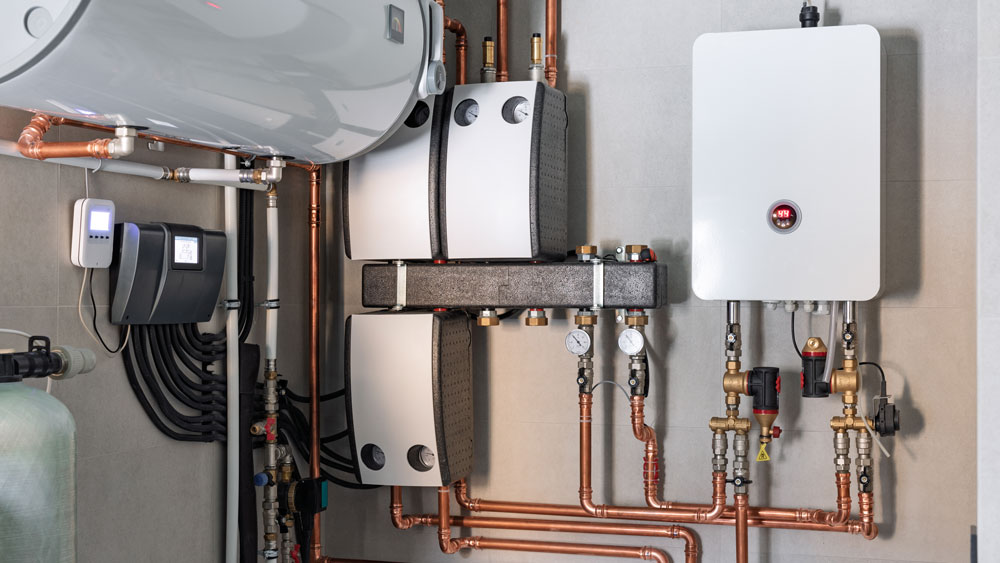
Locating the equipment room centrally within the house improves the distribution efficiency of electricity, water, and airflow. The basement makes an excellent spot, freeing up space and muffling potential noise in the shared living zones. According to Diana, the entry points for utilities into the home from the road and power lines will also influence where the equipment room is built.
Where to Start
Woodhouse optimizes the cost to build a timber frame home by maximizing efficiency, quality, and homeowner happiness. With a long list of on-staff experts and abundant experience collaborating with external architects and other professionals, we are able to craft a smart, safe, strategic design for every project. Wander through our online gallery to see examples of successful projects across the nation. Ready to learn more? Reach out to start the conversation with your Regional Project Manager.
Meet the Experts
Diana Allen contributed to this post. Diana is the staff architect for Woodhouse, The Timberframe Company and has been designing timber frame homes, commercial buildings and equestrian buildings for over 30 years often using passive solar design principles.


